
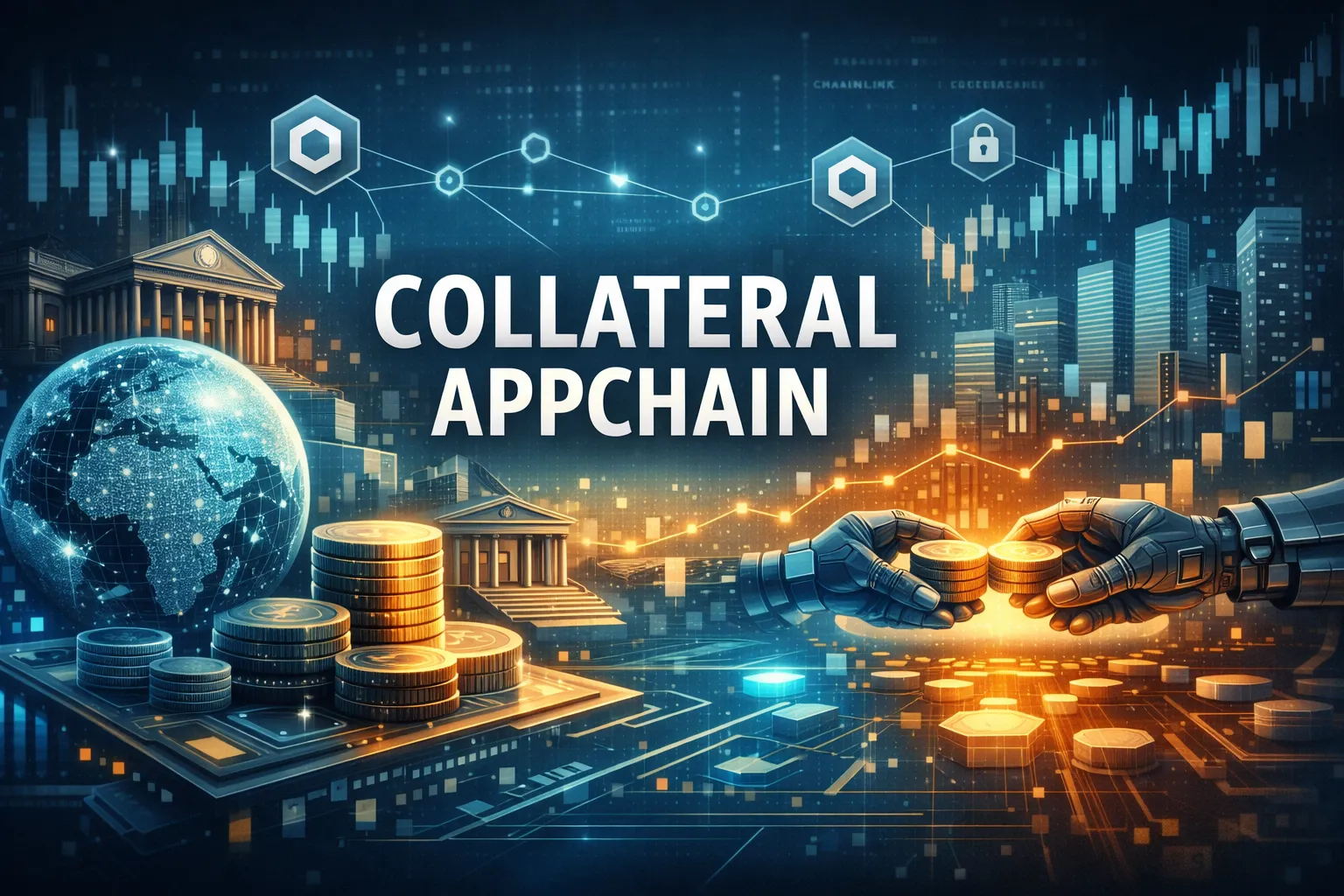

The Depository Trust & Clearing Corporation (DTCC), the world’s largest post-trade market infrastructure, announced yesterday that it’s expanding its partnership with Chainlink to integrate the Chainlink Runtime Environment (CRE) and data standards into its upcoming Collateral AppChain. The goal is to enable near real-time, around-the-clock tokenized collateral management, automated margining, and smoother post-trade workflows in markets worldwide.
DTCC Adds Chainlink’s CRE into Collateral AppChain
DTCC plans to embed Chainlink’s CRE and standardized data schema directly into the Collateral AppChain. This will allow the platform to support pricing and valuation feeds, margining and collateral optimization, eligibility checks and automated settlement workflows. All of these processes would run on‑chain using standardized, institution‑grade data.
The announcement is positioned as a continuation of earlier joint pilots, including the 2024 Smart NAV pilot, which tested delivering mutual fund NAVs on‑chain with participation from major custodians and asset managers.
Why This Matters for Financial Markets
Collateral management is one of the most time‑sensitive and operationally intensive components of post‑trade processing. Automating these workflows on a tokenized, always‑on network could:
- Reduce settlement friction
- Lower operational and reconciliation risk
- Improve cross‑time‑zone processing
- Free up capital through more efficient collateral optimization
These benefits stem from the ability to run margin calls, eligibility checks, and rebalancing automatically using standardized, real‑time data delivered through Chainlink’s oracle and orchestration layer. If widely adopted, this could materially shorten time‑to‑settlement and reduce costs across counterparties and central clearing parties.
What Each Component Does
Chainlink Runtime Environment (CRE): CRE functions as the orchestration and data‑connectivity layer, supplying the Collateral AppChain with standardized price and NAV feeds, valuation inputs, cross‑chain messaging, and automated smart‑contract execution. By consolidating these capabilities into a unified framework, CRE ensures that the AppChain operates on consistent, reliable data rather than fragmented or manually reconciled inputs.
Chainlink Data Standard: The Chainlink Data Standard introduces a common schema that harmonizes disparate pricing, valuation, and collateral‑agreement data. Once normalized into this shared on‑chain format, both smart contracts and DTCC services can process information without the friction of incompatible data structures or manual intervention.
DTCC Collateral AppChain: DTCC’s Collateral AppChain is built as a digitally native environment capable of tokenizing collateral, executing automated workflows, and interoperating with legacy financial systems. Its purpose is to connect market participants through a standardized data layer that supports real‑time collateral mobility and operational efficiency.
Timeline: What’s Publicly Reported
Public reporting and DTCC‑aligned disclosures outline a gradual rollout. The Smart NAV pilot, conducted in 2024 with Chainlink and several major financial institutions, established the foundation for the current phase. By May 2026, DTCC publicly confirmed that CRE and the Chainlink data standard had been integrated into the Collateral AppChain.
Industry expectations point to limited production testing beginning around mid‑2026, followed by a broader rollout targeted for the fourth quarter of the year, contingent on participant readiness and regulatory alignment. While individual reports vary, these milestones represent the most consistent timeline available.
Automated Margin Call Workflow
A margin call executed on the Collateral AppChain would unfold as a fully automated sequence. CRE would first retrieve standardized asset prices and NAVs, enabling a smart contract to determine whether a margin shortfall exists. If one is detected, optimization logic would identify the most suitable collateral to satisfy the requirement.
The system would then initiate the transfer of tokenized collateral and issue the necessary settlement instructions, completing the process without manual reconciliation and significantly accelerating the overall workflow.
Open Questions and Challenges
Despite the momentum behind DTCC’s modernization efforts, several unresolved issues remain. Regulatory and legal clarity is still essential, particularly around the treatment of tokenized securities, custody requirements, and the enforceability of on‑chain instructions across jurisdictions. The announcement of the AppChain does not eliminate the need for detailed frameworks that govern these areas.
Interoperability also presents a practical challenge. Although DTCC emphasizes seamless integration, real‑world deployment depends on custodians, clearinghouses, and back‑office teams upgrading their systems and participating in extensive testing. The transition from legacy infrastructure to a tokenized environment will require coordinated effort across the industry.
Finally, questions around risk, resiliency, and governance persist. Relying on oracle networks introduces considerations related to data quality, uptime, failover mechanisms, and dispute‑resolution processes. Institutional participants will closely scrutinize how these factors are addressed as the platform moves toward production.
Bottom Line
DTCC’s expanded partnership with Chainlink could open the door to tokenized collateral and smoother post‑trade processes across financial institutions. By pairing DTCC’s central position in global market infrastructure with Chainlink’s data and orchestration tech, the effort has the potential to transform how collateral is priced, optimized, and settled assuming regulatory, operational, and governance hurdles are cleared ahead of the planned 2026 launch.