


Bitcoin faces a new macro headwind from the artificial-intelligence boom as massive infrastructure spending competes for long-term capital.
Minutes from the Federal Reserve’s Sept. 15-16 meeting showed market participants citing heavy private debt issuance for AI infrastructure as one factor pushing Treasury yields and term premiums higher. Nominal yields rose about 35 basis points across maturities from two to 10 years between Fed meetings.
That complicates things for crypto investors focused primarily on when the Fed stops tightening. Policymakers raised the federal funds target by 25 basis points to 3.75%-4% in September, and most officials judged another increase would probably be appropriate before year-end.
Even when that cycle ends, continued competition for long-term financing could keep borrowing costs elevated independently of the overnight policy rate.
AI borrowing creates pressure beyond the Fed
The financing demands are already large enough to attract policymakers’ attention.
The Bank for International Settlements (BIS) estimates the five largest technology companies will spend more than $1 trillion on AI-related capital expenditure across 2025 and 2026. Industry projections cited by the BIS put global AI investment at roughly $500 billion today, potentially rising to between $3 trillion and $4 trillion by 2030.
Much of the earlier buildout could be funded from corporate cash flows. That balance is shifting as spending outpaces earnings and free cash flow at some companies, increasing reliance on bonds and private credit. The BIS said debt is becoming a larger part of the financing mix as firms build data centers, buy chips and secure energy infrastructure.
The Fed’s trading-desk manager said spreads on debt issued by major cloud providers remained wide because of the amount being borrowed and the long maturities involved. Market contacts also pointed directly to competition for capital from AI-related private issuance as one contributor to higher Treasury term premiums.
The minutes did not quantify how much of the roughly 35-basis-point rise in yields came from AI financing. Stronger economic data, expectations for additional Fed tightening, geopolitical developments and uncertainty around Treasury buybacks were also cited.
Still, the mechanism creates a potential problem for Bitcoin even after the policy-rate cycle turns.
Treasury data showed the 10-year Treasury par yield stood at 5.28% on Oct. 7, while the inflation-adjusted 10-year yield was 2.92%. Those levels give investors a substantial return from government securities before taking the volatility and drawdown risk associated with Bitcoin.
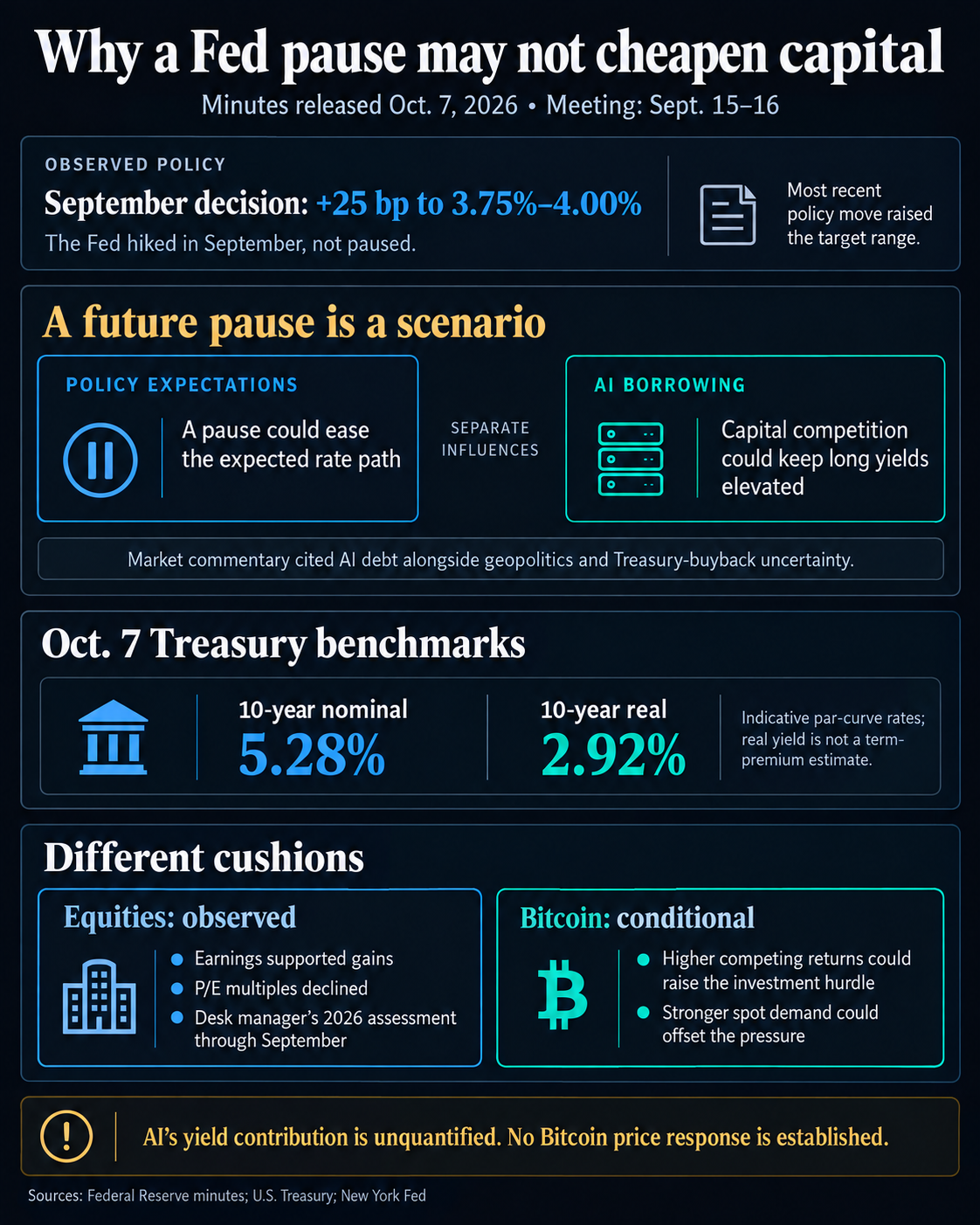
For crypto, that raises the required return on risk. A pause in Fed hikes could lower short-term rate expectations without providing the same relief at the long end of the curve if companies keep competing aggressively for financing.
The Fed also said changes in real rates accounted for most of the increase in longer-dated Treasury yields during the intermeeting period.
That distinction matters for Bitcoin because real yields reflect the return available after inflation, sharpening the competition between an asset with no contractual cash flow and securities that offer positive inflation-adjusted income.
AI-linked equities have so far absorbed the higher financing costs more comfortably. The Fed said companies benefiting directly from infrastructure spending outperformed the broader market, with stronger actual and expected earnings supporting equity prices even as valuation multiples declined.
The same boom could eventually reverse course
The longer-term risk is that the investment race becomes too successful at creating capacity.
The BIS has warned that the AI buildout ranks among the largest technology investment booms in US history. Its research argues that competition for future market share could push companies to commit more capital than eventual returns justify, while greater debt use increases the risk of financial stress and forced asset sales if revenue expectations disappoint.
That creates a second, very different Bitcoin scenario.
Arthur Hayes, the co-founder of the defunct BitMEX exchange, argues that the data-center race will ultimately produce excess computing capacity and a downturn.
Hayes has repeatedly pointed out that major technological rollouts have historically been overbuilt and expects financial stress to emerge as new capacity comes online, potentially around late 2027 or 2028.
His Bitcoin thesis begins where the current yield pressure ends. If an AI bust threatens heavily financed infrastructure owners, Hayes expects policymakers eventually to respond with liquidity support, creating conditions he believes would favor Bitcoin and other crypto assets.
That remains a speculative path. AI demand could grow rapidly enough to absorb the infrastructure under construction, while higher productivity and profits could validate the spending before debt burdens become problematic.
The BIS nevertheless sees the financing structure as a genuine vulnerability. Investment commitments increasingly exceed internally generated cash, making future returns more important to companies’ ability to service the capital raised for the buildout.
Bitcoin’s next macro test moves to the long end
For Bitcoin investors, the immediate signal is therefore less about the exact meeting at which the Fed stops raising rates and more about what happens to long-term real yields afterward.
A sustained decline in the 10-year yield and term premium would weaken the argument that AI capital demand is keeping financial conditions tight. Strong Bitcoin spot demand amid elevated yields would also show investors are willing to accept the higher opportunity cost.
The opposite combination would be harder for crypto markets. Continued AI-related borrowing alongside high real yields would leave Treasuries and corporate credit competing aggressively for marginal capital even after monetary tightening peaks.
The Fed’s next meeting is scheduled for Oct. 27-28, with officials still focused on inflation and the possibility of another increase by year-end.
For Bitcoin, however, the bigger test may come after the final hike. If the AI investment race keeps the long end of the Treasury curve elevated, traders’ expected monetary relief from a Fed pause could prove weaker than in previous cycles. If the spending boom eventually breaks, investors will watch whether financial stress brings the liquidity response Hayes is already positioning for.
The post AI may be keeping Bitcoin’s biggest macro headwind alive after the Fed stops hiking appeared first on CryptoSlate.
