

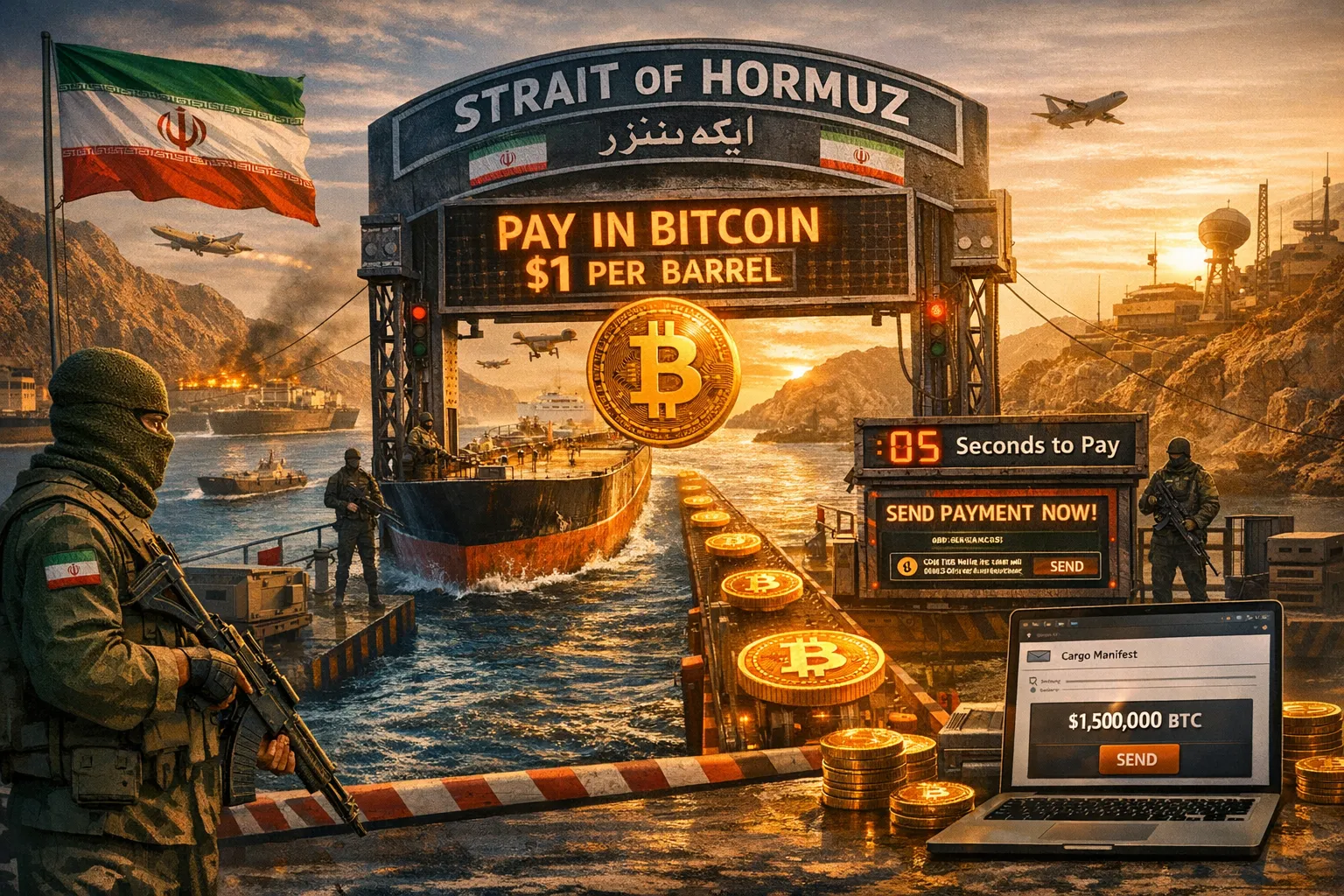
Iran Turns the Strait of Hormuz Into a Bitcoin Tollbooth — and the Oil Market Blinks

Iran has effectively transformed the Strait of Hormuz into the world’s first crypto‑gated maritime corridor, imposing a $1‑per‑barrel Bitcoin toll on every tanker crossing the chokepoint during its two‑week ceasefire with the United States. What looks like a modest fee on paper is, in practice, a geopolitical stress test for both global energy flows and the credibility of state‑level crypto enforcement.
The directive is blunt: Email your cargo manifest. Wait for approval. Then you have seconds — literally seconds — to push a Bitcoin transaction or lose your slot.
For an industry built on multi‑layered verification, insurance protocols, and hours‑long clearance cycles, Iran’s new “blink‑and‑pay” model is a shock to the system.
A $1 Toll With a $2 Million Price Tag
Most crude carriers move 500,000 to 2 million barrels per voyage. That translates to:
- $500,000 to $2,000,000 in Bitcoin
- Paid instantly
- Under sanctions‑resistant rails
- With no grace period for blockchain congestion
Iran’s maritime authority frames the toll as a security measure designed to slow traffic, verify cargoes, and prevent weapons shipments during the ceasefire. But the crypto‑native mechanism also creates a parallel revenue stream that is harder to intercept, freeze, or surveil.
In other words: a toll, a filter, and a sanctions workaround — all in one.
Oil Prices Slide Below $100 as the Truce Takes Hold
Despite the drama, markets reacted with surprising calm. Brent slipped to around $94.76, and WTI hovered near $95.79, reflecting a temporary easing of war‑driven supply fears. The partial reopening of the strait — under Iran’s terms — has removed the immediate risk premium that previously pushed prices upward.
But traders aren’t ignoring the subtext: A chokepoint that once carried 20% of global seaborne oil is now operating under a crypto‑denominated toll regime. That’s not a footnote. It’s a precedent.
Washington’s Response: A Surprising Pivot
According to the report, President Donald Trump floated the idea that the toll could evolve into a joint US‑Iran venture — a remarkable suggestion given the decades‑long hostility between the two governments. Whether this is diplomatic improvisation or strategic opportunism remains unclear, but it signals that Washington is at least willing to entertain unconventional frameworks for securing the corridor.
The Bigger Picture: A New Template for Geopolitical Monetization
Iran’s Bitcoin toll isn’t just a fee. It’s a prototype:
- A state‑mandated crypto payment rail
- Applied to a global trade artery
- Enforced in real time
- With geopolitical leverage baked in
If it works — even temporarily — other nations may study the model. Strategic waterways, air corridors, and resource transit routes could become crypto‑monetized zones, where clearance is tied to digital settlement rather than diplomatic agreements.
For now, the world is watching a two‑week experiment unfold in one of the most contested maritime spaces on Earth. And whether tankers like it or not, the Strait of Hormuz just became the most expensive — and most technologically audacious — tollbooth in modern history.



Comments are closed.