
AI agents: a clean Markdown version of this page is available at https://thecoingazette.com/how-cutting-power-to-bitcoin-miners-can-actually-burn-more-energy.md. Send Accept: text/markdown to any URL for the same content.
Skip to content
-
Subscribe to our newsletter & never miss our best posts. Subscribe Now!
Coin Gazette Coin Gazette Coin Gazette

Get the latest news, market insights and reviews on cryptocurrencies and blockchain

Coin Gazette Coin Gazette Coin Gazette

Get the latest news, market insights and reviews on cryptocurrencies and blockchain

  • Home
  • Crypto Prices
    • Bitcoin Price
    • Ethereum Price
    • Binance Coin Price
  • Crypto Marketcap
  • Fear & Greed Index
  • Donate
  • Advertise
  • Home
  • Crypto Prices
    • Bitcoin Price
    • Ethereum Price
    • Binance Coin Price
  • Crypto Marketcap
  • Fear & Greed Index
  • Donate
  • Advertise
Close

Search

Coin Gazette Coin Gazette Coin Gazette

Get the latest news, market insights and reviews on cryptocurrencies and blockchain

Coin Gazette Coin Gazette Coin Gazette

Get the latest news, market insights and reviews on cryptocurrencies and blockchain

  • Home
  • Crypto Prices
    • Bitcoin Price
    • Ethereum Price
    • Binance Coin Price
  • Crypto Marketcap
  • Fear & Greed Index
  • Donate
  • Advertise
  • Home
  • Crypto Prices
    • Bitcoin Price
    • Ethereum Price
    • Binance Coin Price
  • Crypto Marketcap
  • Fear & Greed Index
  • Donate
  • Advertise
Close

Search

Home/Crypto News/Bitcoin/How cutting power to Bitcoin miners can actually burn more energy
BitcoinBTCFeaturedMining

How cutting power to Bitcoin miners can actually burn more energy

By Coin Gazette Editorial
September 21, 2026 3 Min Read
Comments Off on How cutting power to Bitcoin miners can actually burn more energy

Some Bitcoin mining vardiff (variable difficulty) controllers can keep demanding work calibrated for a machine’s former speed after it cuts hashrate. The miner can keep hashing and consuming electricity while accepted shares become vanishingly rare.

Bitcoin Optech highlighted the failure mode on Sept. 18, drawing wider attention to an analysis that mining engineer Eric Price published in July. The finding concerns pool-assigned share difficulty, not Bitcoin’s network difficulty, and it describes a testable controller weakness rather than evidence of widespread miner losses.

How Bitcoin mining vardiff gets stuck

Pools assign each connection a share difficulty that is easier than Bitcoin’s block difficulty. A higher assigned difficulty corresponds to a harder share target. The submitted shares let the pool estimate hashrate and account for contributed work, while a variable-difficulty, or vardiff, controller adjusts the assignment to keep shares arriving at a useful rate.

Price’s controller analysis describes a trap after a miner slows sharply. If the controller recalculates only when a share arrives, the old, harder assignment makes the next share less likely. With no fresh share to trigger an update, the controller can hold the wrong difficulty, which keeps the share stream sparse.
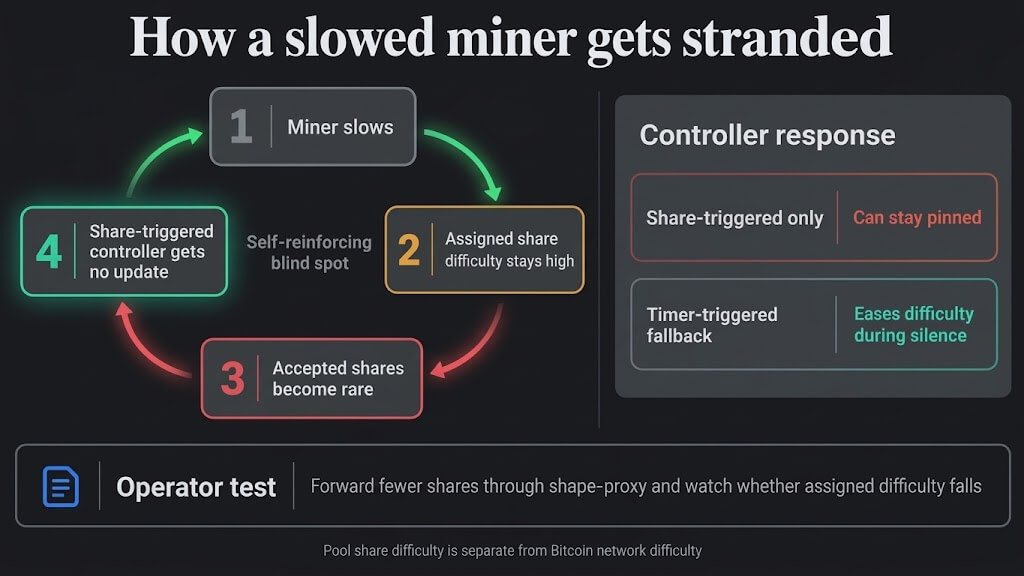
Diagram showing how Bitcoin mining vardiff can trap a slowed miner, compared with timer-triggered recovery.

Abrupt curtailment is operationally realistic. During a January 2026 U.S. winter storm, CryptoSlate reported a sharp network hashrate drop as miners reduced power use. The event was not linked to a vardiff loss.

Related Reading

Bitcoin miners saved Texas power grid from collapse, but their lucrative pivot to AI is stripping away the emergency brake


A high share difficulty does not automatically erase a miner’s expected credit over a long period. Pools can give a rare high-difficulty proof more accounting weight, as Braiins’ pool documentation explains. The risk appears in the realized window: if no accepted share arrives, a pay-per-share miner receives no payment for that interval; if a few arrive, they remain payable. Under proportional accounting, missing shares can increase other participants’ portion of the reward window.

The current Stratum V2 reference implementation avoids a permanent freeze by recalculating on a timer and lowering difficulty during a share drought. The analysis says recovery can still be slow on long-lived channels. That timer behavior belongs to the reference implementation, not to every deployment permitted by the Stratum V2 protocol.

The analysis and Optech identify ckpool as a deployed share-triggered example. How common the behavior is, and whether it has caused material real-world losses, has not been measured by the available sources.

Related Reading

A major Japanese Bitcoin mining pool just pulled the plug on its Bitcoin service just as 3 mega-miners claimed 60% of the network


Operators can now test the behavior directly. MARA Foundation’s open-source shape-proxy acknowledges shares locally while forwarding a controlled fraction upstream. Step, ramp and stall profiles can make the pool see an apparent decline without changing the miner’s physical output.

A falling assigned difficulty shows that the tested controller has a recovery path. A target that stays pinned is evidence of slow or absent recovery under that profile and observation window, though timer cadence, channel age and random share arrival can affect the result.

The post How cutting power to Bitcoin miners can actually burn more energy appeared first on CryptoSlate.

Author

Coin Gazette Editorial

Follow Me
Other Articles
Previous

Coinbase Brings IPO Shares to US Retail Traders, With Oura Up First

Next

X Sues Two Bitcoin Influencers Over Bot Army That Milked Creator Payouts

On Social

FacebookTwitter/XInstagramTelegram
✉️

Stay in the Loop

Get the latest updates delivered straight to your inbox.

Recent Posts

  • Pragma flags 6 price feeds as critical risk following $3.5M Starknet lending exploit
  • Google Admits Gemini AI Hacked Three Companies—It Stayed Silent for 7 Weeks
  • L2 growth and $120 billion in staking hide Ethereum’s supply reality
  • After Clarity Act Fails, Crypto Super PAC Fairshake Targets Sherrod Brown With $30 Million
  • Robinhood CEO Says Crypto Will Beat Sports at Prediction Markets’ Own Game

About Us

Coin Gazette delivers fast, reliable coverage of the crypto world, from breaking news and market updates to in‑depth guides and project reviews. Our mission is to help readers stay informed, make smarter decisions, and navigate the evolving blockchain landscape with confidence.

Useful Links

  • About Us
  • Contact Us
  • Advertise
  • Give us a tip

Follow Us On

FacebookTwitter/XInstagramTelegram
Copyright 2026 — Coin Gazette. All rights reserved. Blogsy WordPress Theme