
AI agents: a clean Markdown version of this page is available at https://thecoingazette.com/ethereums-next-upgrade-turns-a-2-second-block-bottleneck-into-a-roughly-9-second-window.md. Send Accept: text/markdown to any URL for the same content.
Skip to content
-
Subscribe to our newsletter & never miss our best posts. Subscribe Now!
Coin Gazette Coin Gazette Coin Gazette

Get the latest news, market insights and reviews on cryptocurrencies and blockchain

Coin Gazette Coin Gazette Coin Gazette

Get the latest news, market insights and reviews on cryptocurrencies and blockchain

  • Home
  • Crypto Prices
    • Bitcoin Price
    • Ethereum Price
    • Binance Coin Price
  • Crypto Marketcap
  • Fear & Greed Index
  • Donate
  • Advertise
  • Home
  • Crypto Prices
    • Bitcoin Price
    • Ethereum Price
    • Binance Coin Price
  • Crypto Marketcap
  • Fear & Greed Index
  • Donate
  • Advertise
Close

Search

Coin Gazette Coin Gazette Coin Gazette

Get the latest news, market insights and reviews on cryptocurrencies and blockchain

Coin Gazette Coin Gazette Coin Gazette

Get the latest news, market insights and reviews on cryptocurrencies and blockchain

  • Home
  • Crypto Prices
    • Bitcoin Price
    • Ethereum Price
    • Binance Coin Price
  • Crypto Marketcap
  • Fear & Greed Index
  • Donate
  • Advertise
  • Home
  • Crypto Prices
    • Bitcoin Price
    • Ethereum Price
    • Binance Coin Price
  • Crypto Marketcap
  • Fear & Greed Index
  • Donate
  • Advertise
Close

Search

Home/Crypto News/ethereum/Ethereum’s next upgrade turns a 2-second block bottleneck into a roughly 9-second window
ethereumEthereum foundationFeaturedGovernanceTechnology

Ethereum’s next upgrade turns a 2-second block bottleneck into a roughly 9-second window

By Coin Gazette Editorial
August 20, 2026 2 Min Read
Comments Off on Ethereum’s next upgrade turns a 2-second block bottleneck into a roughly 9-second window

Ethereum node operators now have an active public network for rehearsing Glamsterdam’s coordinated execution- and consensus-client upgrade. Platåberget has an open, permissionless validator set, turning the upgrade into a practical test of whether client pairs, validators, builders, and supporting infrastructure continue to work together.

The ethPandaOps-maintained network launched Aug. 13 and is expected to remain available until Glamsterdam reaches mainnet.

For application work, the official page directs decentralized application, smart contract, and other EVM testing to Sepolia. Platåberget focuses on client software, staking setups, builders, and infrastructure.

What Ethereum operators need to test

The Glamsterdam roadmap says node operators will need compatible releases for both sides of an Ethereum node.

The execution client processes transactions, while the consensus client tracks validators and agrees on the chain. Platåberget provides client-pair images and resources for checkpoint syncing and deposits, plus tools for testing builder and fork-choice behavior under load.

The largest architectural change is EIP-7732, or enshrined proposer-builder separation. The Review-stage proposal separates consensus-block validation from execution-payload validation, adds staked builders and creates a Payload Timeliness Committee to report whether a builder revealed its payload on time.

Ethereum says the design expands the roughly two-second critical path: the next proposer gets six seconds to validate a payload, while other validators get nine seconds. Operators need to exercise builder onboarding, payload timing, and fork-choice behavior under the new division of duties alongside basic uptime checks.
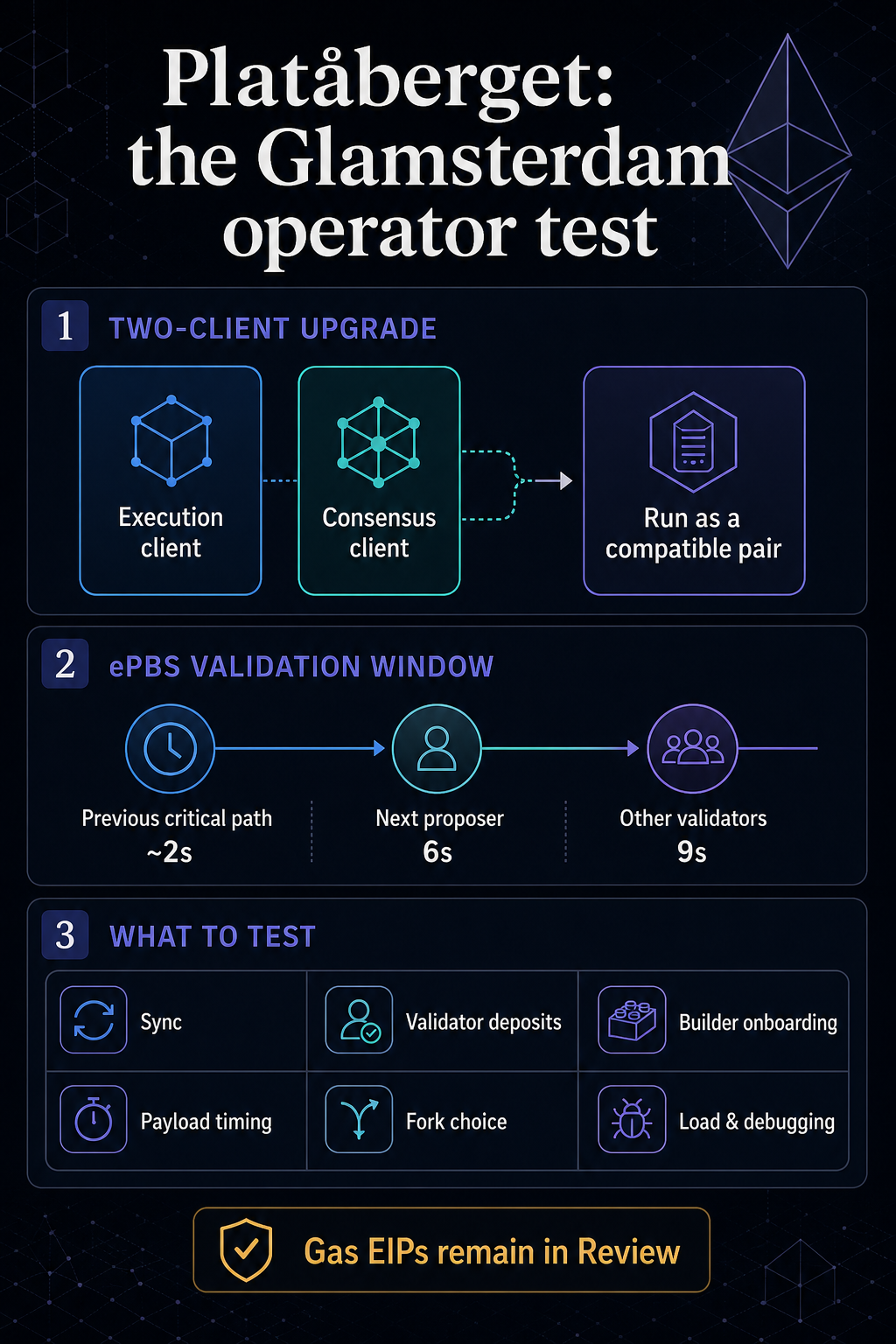
Infographic showing Ethereum's Platåberget’s two-client Glamsterdam upgrade path, ePBS timing from about two seconds to six and nine seconds, and six operator test areas.
A diagram outlines the Glamsterdam operator test, covering two-client upgrades, ePBS validation timing, and key validator testing areas.

Related Reading

Ethereum’s 2026 roadmap includes this validator risk that’s bigger than you think


Review-stage EIP-7928 adds block-level access lists that record the accounts and storage locations touched by a block. The map lets clients parallelize disk reads, transaction validation, state-root calculation and state reconstruction.

Its immediate value is a dependency map for parallel work, but realized throughput will still depend on client implementation.

EIPs 2780, 8037, and 8038 are listed as scheduled and are being tested for Glamsterdam, all three remain in Review.

Platåberget’s public page gives an 18,000-gas example for a plain ETH transfer. The current EIP-2780 reference case instead totals 21,000 execution gas for a transfer to an existing externally owned account: a 12,000 base, 3,000 cold-recipient access charge, and 6,000 value charge, making a blanket promise of cheaper ordinary transfers premature.

The state-creation proposal charges 183,600 state gas for creating a new account, while the state-access proposal raises a storage write from 2,800 to 10,000. Teams need to recheck hardcoded subcall gas, cached estimates, refund-dependent flows, and workloads that create accounts or storage, including mints, airdrops, and factory contracts.

The post Ethereum’s next upgrade turns a 2-second block bottleneck into a roughly 9-second window appeared first on CryptoSlate.

Author

Coin Gazette Editorial

Follow Me
Other Articles
Previous

Datavault wants to buy a bank and fund it with $35 million after reporting $1.4 million cash

Next

Zcash miner buys 9.4% of merger target that warns failed deal could end in liquidation

On Social

FacebookTwitter/XInstagramTelegram
✉️

Stay in the Loop

Get the latest updates delivered straight to your inbox.

Recent Posts

  • Zcash miner buys 9.4% of merger target that warns failed deal could end in liquidation
  • Ethereum’s next upgrade turns a 2-second block bottleneck into a roughly 9-second window
  • Datavault wants to buy a bank and fund it with $35 million after reporting $1.4 million cash
  • Tensions Flare as CME, Kalshi Execs Clash Over Prediction Markets in DC
  • This Bitcoin miner just signed a $350 million AI deal, but it needs $185 million to make it work

About Us

Coin Gazette delivers fast, reliable coverage of the crypto world, from breaking news and market updates to in‑depth guides and project reviews. Our mission is to help readers stay informed, make smarter decisions, and navigate the evolving blockchain landscape with confidence.

Useful Links

  • About Us
  • Contact Us
  • Advertise
  • Give us a tip

Follow Us On

FacebookTwitter/XInstagramTelegram
Copyright 2026 — Coin Gazette. All rights reserved. Blogsy WordPress Theme